our services
Contrast Enhanced Mammography
Contrast-Enhanced Mammography (CEM) is an advanced breast imaging technique designed to provide more detailed insight than a standard mammogram.
By combining traditional mammography with a contrast injection, CEM can detect some breast cancers that may not be easily visible on conventional imaging, particularly in women with dense breast tissue.
In many cases, CEM offers a level of diagnostic detail comparable to breast MRI. It can also help define the location and extent of a newly diagnosed cancer, giving your referring doctor clearer information to guide the next steps in your care, and in some cases, reduce the need for additional testing.
What is Contract Enhanced Mammography?
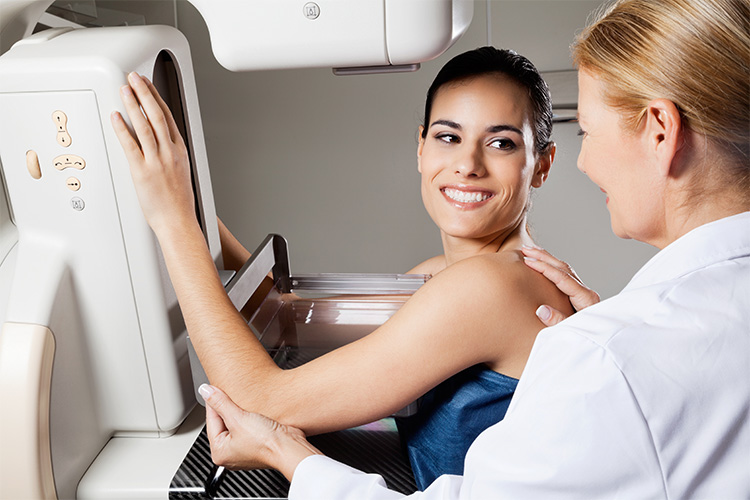
CEM is a specialised type of mammogram that uses an iodine-based contrast agent to highlight areas of increased blood flow within the breast.
After the contrast is administered via a small injection, mammogram images are taken as normal. The contrast allows radiologists to see areas that may be more active than surrounding tissue, which can sometimes indicate the presence of cancer.
Cancers often develop their own blood supply, which is why they can appear as areas of enhancement on CEM images.
The result is a set of images that show both:
- The structure of the breast, and
- Areas of enhancement that may require further investigation
This combination provides a more complete picture than a standard mammogram alone.
Why might I need a CEM?
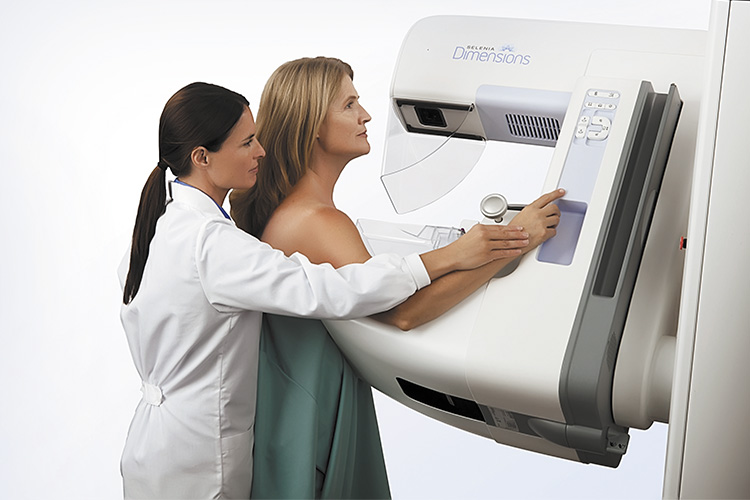
Your doctor may refer you for CEM when more detailed breast imaging is required.
This may include:
- Further assessment of an abnormal mammogram or ultrasound
- When results from other imaging are unclear
- Evaluation of dense breast tissue where standard imaging is less sensitive
- Assessing the extent of a newly diagnosed breast cancer
- When a breast MRI is not suitable or not required
CEM helps provide additional clarity, supporting earlier detection and more informed decision-making about your care.
About Your Test

Before Your Appointment
There is no special preparation required for a CEM examination, however a few simple steps can help make your appointment as smooth as possible.
Eating and hydration
Some patients may feel mild nausea after the contrast injection, so it’s best not to have a heavy meal. Staying well hydrated before your scan is also recommended.
Medications and medical conditions
Please let our team know before your appointment if you:
- Have kidney problems or reduced kidney function
- Have diabetes, particularly if you are taking metformin
- Have had a previous reaction to contrast dye
In some cases, you may be asked to have a recent blood test (eGFR) to check your kidney function prior to your appointment.
What to wear
You may be more comfortable wearing a two-piece outfit, as you will be asked to undress from the waist up and wear a gown.
On the day
- Please avoid wearing deodorant, lotion, powder, perfume, or oils on your chest or underarm area, as these can affect the images
- You may be asked to remove jewellery or metal objects before the scan
- Please bring your referral and any relevant previous imaging if you have it available
Arriving a little early can help ensure everything runs smoothly on the day.
On The Day
Your examination will be performed by a female technologist who specialises in mammography. She will explain the procedure and may ask a few questions about your symptoms and medical history.
You will be asked to complete a short questionnaire and sign a consent form before the scan begins.
A small intravenous (IV) cannula will then be placed into a vein in your arm so the contrast dye can be administered.
The CEM exam itself is very similar to a standard mammogram. Each breast is briefly compressed for a few seconds to obtain clear images. While this can feel uncomfortable, it should not be painful. Our technologists are highly experienced in making the process as comfortable as possible.
As the contrast dye is injected, you may notice a warm sensation spreading through your body or a metallic taste in your mouth. This is normal and usually passes quickly. Please let the technologist know if you experience any pain in your arm or feel unwell at any time.
During the 3D component of the scan, you may notice the X-ray arm moving in a gentle arc as it takes multiple low-dose images in just a few seconds.
The appointment typically takes around 15–20 minutes, slightly longer than a standard mammogram due to the contrast component.
You may be asked to wait briefly afterwards while your images are reviewed to ensure everything needed has been captured.

After Your Appointment
You will be asked to wait briefly whilst your images are checked. Sometimes further mammogram images are required, or an ultrasound is then performed. This is not uncommon and simply helps ensure we have the most accurate information.
If you have had no reaction to the contrast, the IV line will be removed and a small bandage applied. This can usually be removed later that day.
It’s important to drink plenty of water after your appointment, around 6 to 8 glasses over the next 24 hours, to help your body clear the contrast dye.
Depending on your results, your doctor may recommend further tests such as an ultrasound, breast MRI, or biopsy. If this is needed, it will be discussed with you as part of your follow-up care.
Frequently Asked Questions
A standard mammogram uses low-dose X-rays to look at the structure of the breast, helping detect lumps, calcifications, or other changes.
CEM builds on this by adding contrast, which highlights areas of increased blood supply.
In simple terms:
- A mammogram shows what the breast looks like
- CEM shows what the breast looks like and how it behaves
This makes CEM particularly useful in dense breast tissue, where cancers can sometimes be harder to detect.
CEM is not a replacement for a mammogram, but it can provide more detailed information when needed.
A mammogram remains the first step for routine breast screening. CEM is typically recommended when further investigation is required or when more detail is needed to assess a specific area of concern.
In these situations, CEM can detect additional findings and provide a clearer understanding of what’s happening.
Both CEM and breast MRI use contrast to detect abnormalities and assess how breast tissue behaves.
CEM can provide similar diagnostic insight in many cases, but is:
- Faster
- More accessible
- Often more comfortable for patients
It is often used as an alternative when MRI is not suitable or necessary.
The scan itself is quick, and your appointment will usually take around 15–20 minutes.
Yes, you can return to your normal activities straight after your appointment.
CEM may not be suitable for some patients, including those:
- With certain kidney conditions
- With a known allergy to iodine-based contrast
- Who are pregnant or may be pregnant
Our team will assess your suitability before your appointment.
Yes. Our radiographers use special techniques and additional images to safely capture clear images around implants.
You can still have mammograms. Just let your radiographer know about your surgery so positioning can be adjusted appropriately.
Yes. A referral from your GP or specialist ensures the correct test is performed.
Your CEM will be reported by a specialist breast radiologist, which can take some time because there are many images to look at and compare. Results are therefore not usually available immediately. We will send a report to your referring doctor.
Please ensure you have an appointment booked with your referring doctor to discuss these results.
Safety and Risks
Contrast-Enhanced Mammography (CEM) is a safe and widely used imaging technique. Like any medical test, there are some considerations, but for most patients, the benefits of the scan far outweigh the risks.
Radiation exposure
CEM uses slightly more radiation than a standard mammogram, however this increase is small, around the equivalent of one additional mammogram image. The total dose remains well within established safety guidelines.
Contrast injection
CEM involves an iodine-based contrast injection, similar to what is used in CT scans. Most patients tolerate this well.
Some patients may experience a mild reaction, such as itchiness or hives. More significant reactions are very rare but can include symptoms like shortness of breath or swelling. Our staff are fully trained to recognise and manage these reactions promptly.
Before your appointment, please let us know if you:
- Have kidney disease or reduced kidney function
- Have had a previous reaction to iodinated contrast
- Are taking diabetes medication such as metformin
- Are pregnant or may be pregnant
CEM is generally not recommended during pregnancy.
Your care team will assess your individual circumstances to ensure this is the most appropriate test for you.
It’s important to keep in mind that your doctor has recommended this examination because the clinical benefit of the information it provides is considered to outweigh the very small risks associated with the procedure.
Your comfort and care
We understand that breast imaging can feel a little daunting, especially if it’s something new.
Contrast-Enhanced Mammography (CEM) is performed in a similar way to a standard mammogram, including brief breast compression to obtain clear images. While this can feel uncomfortable, it should not be painful. Our experienced team will take the time to position you carefully and support you throughout the process to make it as comfortable as possible.
The scan itself is quick, and most patients are able to return to their normal activities straight after their appointment.
At Diagnostic Imaging for Women, we focus on creating a calm and supportive environment where you feel informed, reassured, and well cared for every step of the way.